2 Jun 2013

All the parties

 Started last Saturday, 24th May, with a parade in Bluefields

 With old misses
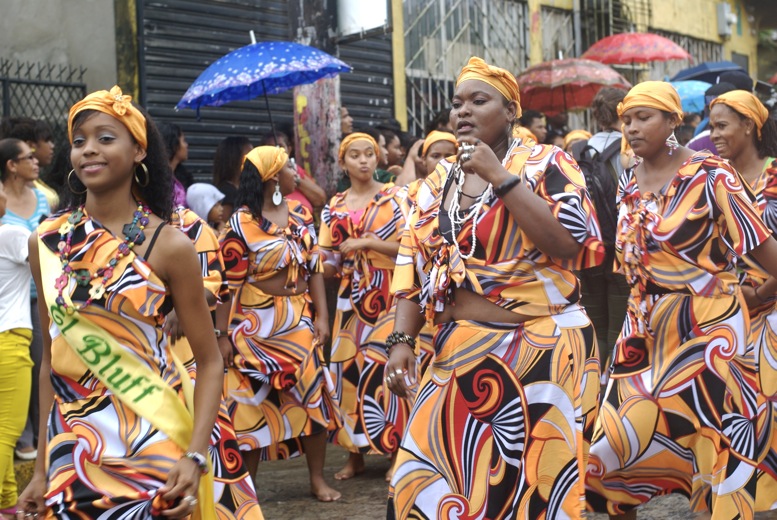
 young misses

 young gentlemen

and old ladies, all dancing through the streets

We took breaks from working (and we worked hard) with the information work we'll be doing, writing articles and publishing stories from our experiences, by going out in the streets to watch parades and meet people. We met friends of friends, were invited to concerts, saw Miss Bluefields in the park, made rondon (local dish) and had another concert with our new friends, had a goodbye dinner and went out to see another parade and went to another concert and went out dancing again, then went home to sleep two or three hours before catching the morning panga on Saturday. We left Bluefields. We left Rama. We left RAAS, the region. We arrived in Managua, and left that too. Now we've been one day in Granada, seeing things and jumping off boats, and tomorrow I'm going to San Juan del Sur, all on my own, leaving the other girls completely behind for the first time since January 2013.
Adventure. And stuff. 

29 May 2013

Bosawas

Astounding nature reserve, where indigenous people happen to live,
where other people are closing in on its borders and cutting down trees and more trees.
More to come. 

27 May 2013

How to run your farm

 Plant a lot of fruit trees, in seemingly random order
Throw some palm trees in there, especially close to your house

Then bring your Norwegian visitors out between the trees, and astound them by pointing out that every tree is of use and has a fruit on it, and gather guava, mango, some random fruits that look like nothing else, and pick the cashew apples with cashew nuts on them.
This is the farming alternative they are trying to encourage the farmers to do, the old fashioned way of having a little bit of everything. Increasingly, poor farmers in the area are selling off their land to the african palm company at Kukra Hill, or planting just one type of tree, or plant, because they can, or think they can, earn more selling it and then buy their food instead of growing it.

And I wonder whether it's not just me (and some organisations) being romantic, wanting the farmers to live in the past, working only to feed themselves and their families, while I myself "need" money to travel, to buy food, clothes, and equipment. I think the answer must lie somewhere in between.

25 May 2013

Just kidding

We're not on Corn Island, we're back in Bluefields since yesterday. We had a discussion about where would be the most practical place to work - and where people would be more likely to work - and ended up just going back to Bluefields. We had plane tickets from Bilwi to Corn Island via Bluefields, so it was easy enough to jump off here, even though it might have been hard to give up the dream of going to a Caribbean island.

Anyways, we're here, where internet is scarce as ever, trying to finish and work on several products at once, as well as being social and having a good time before we leave in a week's time.

This part of the project will then be over, and I doubt we will ever be all nine together in Nicaragua again. We will meet for seminars and planning and arranging talks and activities all this autumn, and of course I hope we'll stay friends, but this, this being together, sleepingeatingworking together will be over very soon.

Ms Suzanny's farm

is a chicken perched in a tree, by Ms Suzanny's farm

We stayed three days by Ms Suzanny's farm. She couldn't come herself because she was ill (and all Rocky Point people have houses in Pearl Lagoon, the town), but we stayed with her daughter Mirla and Mirla's husband Jean. We got to walk far and visit a very strange man who had been in the US Marines far too long, I showed off my coconut milk making skills, Johanne had a fever and then we left. It was very peaceful being there, in the middle of the woods (as per usual), with a slightly younger couple than the others we have stayed with.

23 May 2013

Rainy Season

 Started one day, 26th April, ended the same day, 26th April

And there was nothing to do but get everything in and stay inside

The rainy season here is supposed to be between May and December, and it's the "winter" in Nicaragua. Ms Florence kept saying the 15th of May, and she seems to be right. We started with one day of forewarning, the 26th of April. And I am telling you: Rain. It is amazing and astounding and completely unimaginable, how much it's possible to rain in one day, or at once. And this comes from someone who has lived in Falmouth, England. More rain than the most heavy, hard rainfall you can imagine in Falmouth, and we did have some rain there too. I feel bad for the next group coming here, since they will be here between September and December, and get a lot more winter than us.

21 May 2013

Turkeys and outdoor showers

 Hello, unfriendly male turkey, you must be looking for

 your wife, hatching eggs all day inside the latrine, keeping us humans company
or maybe you're cross after running into Johanne showering down by the well?

By Ms Florence, we shared our latrine with a massive female turkey trying to hatch her eggs, poor thing. We also had a flimsy curtain in front, looking directly at the house. Our sense of privacy was further challenged by the fact that the bath was the forest - that is, the trees down by the well, not too far from the house either. This is when you learn to trust in people and hope for the best. And it's perfectly fine.

19 May 2013

Jack/animals in captivity

 Jack, my dear friend
                                                                     And Johanne's best friend and hair eater

We've seen this so many times: monkeys and parrots in captivity, the birds with their wings clipped and the monkeys on leashes or just short ropes. Jack was caught by Ms Florence or her son, and has been staying at their house at least two months from when he was just a baby monkey. He showed clear notions of distress, constantly running up and down, shying away from both his owners, and aggressively tearing off bits of the cane the house was made of and eating it. Again, I shouldn't be surprised that people don't think about the feelings of animals, but they really don't seem to notice it at all.

17 May 2013

GRATULERER MED DAGEN

Norway Day 2012, random person, Ingrid, Christine, me and Xiomara

Today is Norway Day, if anyone had forgotten. And I'll be celebrating it in a minivan with the girls in my group, but also with our coordinators, one of whom doesn't like the nationalism implied in celebrating the constitution day. I'll try to eat some ice cream and cake if I can find it.
Here's a greeting to all Norwegians and friends-of-Norwegians (so that's all of you then): Hurra! Hurra! Hurra!

15 May 2013

By the way, on my way

Plans are changing all the time, so now I'll be

14.-16. May: Managua, meetings and more meetings
17.-24. May: North Atlantic Autonomous Region (RAAN) - meetings and more meetings - exciting
24.-30. May: Corn Island hopefully, working and chilling at the same time
1. June: Leaving Bluefields, finished, hopefully going to the Pacific side for some time and then maybe Costa Rica way.

Conclusion: I'll be gone the next two weeks without much internet access (again), so please expect only infrequent updates.

14 May 2013

Ms Florence & Don Juan

 The first two weeks of this stay, we were with Ms Florence, her husband Juan and 

 Jack, a monkey they had caught and kept on a leash

 And the most beautiful flower garden at Rocky Point

Here they are: don Juan (89) and Ms Florence (67)

These two are the most amazing couple. They got married when he was 45 and she 23, after he'd followed her to the Atlantic Coast to ask her parents for her hand. They have eleven children, as far as I can remember. Don Juan is a "Spaniard" from the Pacific side of Nicaragua, Ms Florence a creole lady from Rocky Point. He never learned English/Creole English through their 40-odd years of marriage, she speaks a mix of Creole and Spanish, and will just switch over any minute. They both work hard at the farm every day, she wears skirts (and short ones too) no matter what she's doing, chopping, weeding, getting the cows in.

I learned to clean the area around the cocoa trees with machete, ground cocoa beans, and finally, how to cook rice and beans with coconut milk. The new families we've been with now have been amazed at how Johanne and I can grate coconut and make coconut milk, which we've been experts on since we first stayed with Ms Connie. The best thing about this stay was coming back and feeling more at home at Rocky Point - we knew the people, the bus schedules, the small paths through the woods, the cuisine, and it felt like a second home.

13 May 2013

Lush

That's all

Will write more cohesively later

11 May 2013

Bluefields, boy

Looking pale as always

I'm here again, and it feels like such a short and such a long time since last I was here. We're only staying until very early Tuesday morning, when we leave for Managua, then the Northern Atlantic Autonomous Region (RAAN) to meet more mayangnas (another ethnic group) and visit some mines. Internet is scarce, but I'll try to post some more before I go.


I miss Rocky Point already.

8 May 2013

Happy Birthday Henry

My good friend H.

I think I raved too much about this last year, but imagine, without Henry Dunant there would be no Red Cross. There would probably be different charities, just like now, but no Geneva Conventions, no neutral organisations to work in war time... This man, seriously.

6 May 2013

Religion

Our second farm stay in Rocky Point back in March was with Seventh Day Adventists. It was a more difficult stay than at the previous farm. Partly because we had very different personalities, partly because of their religion. They don't eat shrimp, don't allow dancing, don't drink caffeine (this also includes black tea, of course), and probably have more rules that we weren't aware of. While their religion has many beliefs, and is very open about discussing the Bible – even in church, they have discussions – the main difference from other adventists, the most obvious from other churches, and what meant most to our hosts is that they keep the Sabbath holy – i.e. Saturday.

I am certain that Seventh Day Adventists are nice people. Even in Rocky Point (which is where I know the most) there are others, more open, more relaxed. But these ended up being specifically provoking, because they were so closed. What they spent their entire Friday night and Saturday – all day- preaching, was the different Bible verses where the ten commandments are mentioned, and putting a lot of emphasis on the word Sabbath – which in the Norwegian Bible, as far as I know, is "resting day".

I'm trying not to write too much about this, since religion can be very difficult. But my main point is this: If your entire church attendance is spent on repeating the ground rule of your religion, I don't think the religion is doing you much good. If all your days are spent praying (0500-0600 am and 0800-0900 pm), when do you get to be a good person, like you are praying for?

But also, this is what I wrote in my notebook when we stayed one night with some other (very nice! Very busy doing good things and not discussing the Sabbath all day long!) Seventh Day Adventists:

A religion that means it's more accepted to make fun of someone with Down's Syndrome than to dance a little – both in front of your mum – can't be a healthy religion.

29 Apr 2013

Gratulerer med dagen, Elisa

Margetshöchheim, Würzburg, Germany, May 2011

My cousin Elisa will be fourteen years today, if I haven't completely miscounted. This weekend she'll be going through her Confirmation, a sort of coming-of-age-rite in both Norway and Germany. It used to be religious, but, especially in Norway, is now more of a standard thing teenagers go through, with a ceremony, a family feast, and presents. I really want to go, to see my family in Germany, but it doesn't compute with being in Rocky Point, far, far away.

Gratulerer med dagen, og gratulerer med dagen på søndag!

26 Apr 2013

Blue Energy

 Chris and Stephanie - really wonderful people

This house now has an outdoors light and an indoors light


Blue Energy is a company that works at Rocky Point and in other communities, but are based in Bluefields. We've met several representatives, especially when we went to help them with setting up solar panels at a house in March. We even met one in Managua during our holiday. They all seem lovely, and very into their work.

The only thing I wonder about is what they are. NGO, they say. Non profit organisation, their website and Wikipedia (LINK) says. Blue Energy consists of several employees, and many volunteers. There are different volunteer programs, some of the shortest ones are called internships. Their website makes it seem as if they give the communities they work with, all the water, sanitation, and electricity they could want, if only you would donate some more money.

I like Blue Energy. I think a lot of what they do is important. It is true that a lot of the families at Rocky Point wouldn't have electricity without them. But they fail to mention (or at least they try to obscure) that the villagers pay for what they get. Let's take solar power as an example. They have a program for rural, poorer areas, which means that the owner of the house pays 25% of the price for a solar panel, which is about 25 USD. Then, the volunteers/interns pay – voluntarily, but if not, you can't join the program – the other 75 USD. And if you're not from a rural, poorer area, you're paying full price. And as good as solar power, wind power, and getting clean water, can be, I don't think it's right to promote this image of charitable volunteers that they do like to spread. Here is a slightly critical, and also slightly weird, interview.

Being here brings up a lot of thoughts and discussions about charity, about donations, about companies and organisations and how we aim to help others. Even one person I talked to from Blue Energy admitted that some of their projects weren't a resounding success.

All that said, Blue Energy does a lot of good work. I'm just sceptical to companies that have the volunteers pay to work for them.

21 Apr 2013

Back to the holiday

 We went to Isla de Ometepe, where we some of the most beautiful sunsets

 Sunniva, Gro Malene and Julie, some of the most beautiful women (just kidding)

 (Not really)

 Some big, old volcanoes

 Some monkeys

And then the two volcanoes once more

Our holiday at Ometepe started in a lousy way, when we realised the hostel we had was far from everything, taxis were ridiculously expensive, and all the other hostels on the island were packed with Easter tourists.
Then on Thursday (we came on Monday) we went to one of the towns, had a good breakfast, and went sightseeing with a guide to drive us around. We went to a point where we could see both volcanoes, and then we went to a mineral pool far into the woods, which was also packed with Easter tourists, but which was also cool and tranquil and nice. Later on we went on a walk to a nearby lagoon, spotted some monkeys, I climbed a tiny hill, and we met some random Nicaraguans that we had dinner with and got to practice Spanish with. Do-it-all-Thursday.

I'm now trying to plan my holiday in June, so if anyone has any Central America- travelly tips, you're more than welcome to share them with me.

16 Apr 2013

Back to our communities

Photo: me
 Johanne and I stayed in Rocky Point, which you've probably heard enough about by now. In short, it is a mostly black creole farmer community, close to Pearl Lagoon, where people live on separate farms. We've learnt how to make coconut oil, and how to eat anything made with coconut and coconut oil.


Photo: Line Bellingmo Johnsrud
 Ingrid and Line stayed in Orinoco, a Garifuna community which lives mainly off fishing. They've learned to dance, drum, make rondon and eat pretty much anything.


Photo: Mathilde Gabrielsen Vikene
 Mathilde, Julie and Nadia have stayed with a school at Wawashang, meeting students from all the different communities and ethnic groups, having classes in Spanish and Geography. They've also stayed at the nature reserve of Kaka Creek, and with a mestizo family on a farm in the area.


Photo: Elise Øksendal
Gro Malene and Elise have stayed in Kakabila, a Miskito community where people live off fishing and farming. They've stayed with many different families, worked with houses, in the woods, and are now going to paint a mural with the children there.

Everyone is going back to their previous communities in the same groups as before. We would have been able to change places - and partners- if we'd wanted, but noone seems to want to. After spending one month getting to know people, getting into a culture and their practices, you don't want to start all over again. All the villages here are distinct from one another, and most of what we hear from one another is different.

14 Apr 2013

New itinerary

10th April: Pearl Lagoon – political program, meetings

14th April: Rocky Point – new families/farms, still with Johanne

10th May: Back to Bluefields. Political program, writing, working with information, planning what to do when we come back to Norway

1st June: Holiday-time, program finished. Spanish school? Pacific Coast? Costa Rica? Who knows?

26th June: Fly home

27th June: ARRIVE in Tromsø

12 Apr 2013

Spoilt child

How most meals are cooked in Rocky Point - this is the improved oven

That's me.

I first realised when I moved to England and moved into student blocks on campus, and everyone else were exclaiming happily about the water pressure in the showers while I complained about the dingyness of the kitchen. The second year there, we moved into a student house, and my Norwegian housemate and I complained about the carpeted floor (difficult to hoover) and the green-painted kitchen. The others were happy to have a student house that mostly worked, albeit without internet the first six months.

What I realised was that even in (Western) Europe, where I'd imagined (I was but 19 years, remember) most things were similar, Norway is a country with a lot of luxuries built-into everyday life. Like constant hot showers.

So when I finally went to Nicaragua in February, I was oddly enough quite prepared for meeting the different standards. Because I'd gone to England, which I find weird. Yes, it did take a while to get used to bucket showers, and having to get water from the well to flush the toilet. But it didn't shock me. And I realised how lucky we were, coming from Norway to visit this country – we all know we're going back to running water and electricity-filled houses.

Then we went to Guatemala, and I realised that even Nicaragua was luxury. Not in terms of water – it's pretty much the same. But in being able to live in peace, without worrying about the state, or companies, taking over your land. Without an active military getting into your business. Living in Nicaragua isn't always that easy either, but people here are more relaxed – because they can be.

So yes, to conclude this jumpy text, I am a spoilt child. Again, sometimes I wonder what we are doing here, coming as visitors to see how people are living, lowering our standards, hearing what they've experienced, happy that it's never happened to us, and then leaving again. To super-ultra-mega-safe Norway, where hardly anything happens. Where we have all the luxuries without realising they are, in fact, luxuries.

11 Apr 2013

Back in safe Nicaragua


I'm back, I'm back! Well, I was back on Monday already. We've been in Bluefields two days, and we're going to Pearl Lagoon to have a program with meetings there, before continuing on to Rocky Point. Pearl Lagoon is the closest town to Rocky Point, so I'm getting closer and closer to my second home.

Coming back from Guatemala, Nicaragua feels like the safest place in the world. Almost. And, as we've been told repeatedly, it (Nicaragua) is one of the safest countries in Central America. We have had our security routines here as well, but they don't differ that much from what I would follow in London or Oslo. Don't walk out alone after dark, don't walk down certain streets/areas after dark even if you are together, and so on.

Guatemala had a lot more security, and it stressed me out. I had some horrible dreams in Guatemala city. My mood changed rapidly, and even if everything looked nice and quiet on the surface, after all we'd been told, it was difficult to feel at ease. It might just be my imagination, but I feel a lot more relaxed after we came back to Nicaragua, and especially Bluefields, which is in an area with a lot of drug traffic.

I'm looking forward to being back at Rocky Point soon – my second home, where you only need to stay away from the mainroad, don't wander the woods after dark and maybe don't go alone too much as a woman.

10 Apr 2013

Good harvest/good corn

 That's what Chabil Utzaj means - a sugar refinery/company in Alta Verapaz, near Panzós

 Looking very attractive from the road

With some black smoke enhancing the pretty view

The sugar cane plantations have taken over a lot of the areas we visited. Even while in the meeting, talking to people about the problems, there were trucks driving past, loaded with sugar cane. Later on, we drove past the ill-smelling, black-smoking factory. The sugar cane is a very obvious, very visible example as you drive through the countryside, but there are other, as bad or worse, companies in the area. The problem is the richness of the country in terms of natural resources, good earth, many rivers, petroleum and metal. Rivers can be dammed, earth used for African palm trees – which makes it unusable for anything else, and hills can be delved into for precious and/or other metals. The companies seem to take no responsibility whatsoever, whether about the environment, the people, or just following the actual contracts they have signed. Because of all this, rivers are drying out or getting contaminated. We have corn only growing to half its original size, and crops failing. We have children and adults getting gastritis, cancer, and unexplained illnesses and rashes.  

What is the solution? Meetings, meetings and more meetings. First the population needs to be aware of their rights. Second they need to be able to arrange meetings with the local authorities, with the local people, to have a dialogue about all this. Thirdly, the meetings need to be taken seriously, which they rarely are. Many of the people we have met have experienced that the authorities just walk straight over them, after having all these meetings and making agreements that will at least benefit the locals slightly more than the alternative. We also met a representative from charity church organisation Caritas, who had worked with these issues many years. And as she said, you can work for years without seeing any progress at all. You just need to keep on, informing people, going to meetings, and hoping that at some point it will work.

We have also met a few who have managed the impossible, and changed the outcome, and saved some of their own environment – but I can't even remember who, or when, or where, because we've met so many who have said the opposite.

This is also directly tied up with the film I posted the other day: Evictions in the Polochic Valley. This is in the Polochic Valley. The owners of the company are the Germans in the film.

Want to read two completely different views on this? My view is, as you can tell, much closer to the people's one, because that's what I've seen and heard as well. I also generally believe more in people's stories than those of employees in a for-profit company.

9 Apr 2013

Alta Verapaz/Polochic Valley

 We went to the Alta Verapaz from Thursday to Saturday, with one village meeting on Friday

 Where we met many people from different villages

 And heard many stories about the war, and the evictions that are still going on

Like this man and his community, who were facing eviction only a few days after the meeting


Alta Verapaz, in the north of the Polochic Valley, was one of the municipalities in Guatemala that was greatly affected during the war, and is still being affected. Now, there are a lot of companies coming in with massive projects, be it sugar cane and sugar production, palm oil, petroleum, hydro power stations, or just mining, and taking over people's land. Funnily enough, some plans for hydro power stations have been leaked, and they were signed in the late 70s – just about the time the military started barging into the areas. The mostly indigenous population of the area were accused of being guerrilla soldiers or supporters, and then got rid of through an unimaginable amount of massacres.

There has also been released information about this strategy in the neighbouring municipality of Quiché, called Plan Sofia.
When people understood that the military presence wasn't there to protect them, but rather to get rid of them at any excuse they could find, they were more prepared. When they saw militaries advancing towards their village, they would run up into the mountains with everything they owned, while the army burned down the village and beat, raped, and/or killed anyone they could find.

People would stay in the mountain, meet up with each other, try to live off what they could find, while they watched their children die from malnutrition, or their parents from wounds.

This is one of the most common stories we've heard while in Guatemala. And again, it's incredibly sad when this becomes the normalcy. Everyone has a story about their family members getting lost or killed or just plain disappearing.

Now, after the peace accords were written in 1996, you would think at least some things had changed for the better. And all right, there is less of an open war. It is more quiet now, less massacres, more subtlety. But the large companies are buying or leasing land that has belonged to generations of indigenous people. Not necessarily from the people themselves, rather from their rich landowners, who use this opportunity to throw people out of their homes – or evict them, whichever you prefer. These people haven't had papers on their land before, because they have always lived on their own land. In addition to that, we have the waste from the factories, polluting and contaminating the water and the earth – and finally the people.

The state is on the side of the companies – companies that bring a lot of money into the pockets of the higher classes. The local authorities are soon on the side of the companies – they don't get paid very well to begin with, so why not accept a little side income?

We even met some people from a community that is going to be evicted (last photo) – they might actually have been evicted already, the past few days. They wanted us to sign a paper to complain to the local government – saying that we and some of the other organisations in the meeting supported them and their cause. And we couldn't. Partly because it's not how our organisation works, partly because if we did, the Guatemalan state wouldn't let our organisation work more in their country – a country LAG is very far into with different projects. It was very difficult, being there, meeting all these people, and suddenly realising that we have very different ideas about what we are doing.

What are we, after all, doing here? Just listening to different people at different meetings, different organisations, trying to remember who said what and not really doing anything to help them in the moment. The most important thing must be to get the information out to people, I guess.

8 Apr 2013

Guatemala, goodbye

Somewhere on the road, one hour from Guatemala City

Sunday was our last day in Guatemala city, and today we're all going back to Nicaragua, tomorrow Bluefields, and this weekend we'll be going back out into our communities. I'm looking forward to something as safe, both mentally and actually, as coming back to Rocky Point.
We have met a lot of organisations, heard a lot of stories, and finished this past weekend with going to Polochic and meeting people from villages in this area. Both people who had been evicted in the past, and people who were just now in danger of being evicted from their earth. More about that later.

It has been a week full of roller-coaster feelings, from incredibly strong moments when listening to victims of the war, to ridiculously entertaining moments when sitting in a mini bus with eight other, just as tired, girls. It seems like we tell more jokes and do more silly things these days, like we are frantically trying to get away from the sadness and awareness that we're experiencing every day here.

I am very glad that we went here for this program, and that I went to Nicaragua with this organisation.

6 Apr 2013

Evictions in the Polochic Valley

Another documentary, just for you

This is where I have been the past few days. This video was made two years ago though, and there's no danger for us (we're neither landowners nor indigenous people). After so much information and meetings, I'm still astounded by what people are capable of doing to each other. I shouldn't be, but I am. Hoping to have some photos soon (during my first four days in Guatemala, I took none).

5 Apr 2013

And more to bring you down

On Monday, when we arrived in Guatemala, we went fairly straight to the trial I mentioned yesterday. In short:

"Jose Efrain Rios Montt, who ruled Guatemala for nearly seventeen months during 1982 and 1983, and Jose Mauricio Rodriguez Sanchez, his then chief of military intelligence, are on trial in Guatemala City for genocide and crimes against humanity. The charges arise from systematic massacres of the country’s indigenous population carried out by Guatemalan troops and paramilitary forces during this phase of the country’s long and brutal civil war, and the related mass forced displacement." Trial Background

You can also read more about it here if you read Spanish/use Google translate.

I thought Nicaragua had a dark history, but Guatemala beats it by far. We've already met countless people who've told us their story - and you know it's bad when you think "yes, yes, I know what's coming, the army killed your entire family, then you hid in the mountains, more people died, and now thirty years later, you're close to getting some justice". It's sad when this seems to be a common story among the people.

Before all that though: here are some of my notes from the trial:

  • Rios Montt is laughing in the breaks and chatting with his lawyers.
  • Earlier, there was a witness called Fernando, who cried when he told about his children, his daughter who died when she was eight because of the bombs.
  • Now a woman is crying while talking about running, I think they lived in the woods, children, nephews and nieces, mother, uncle, brother, all died. No clothes no salt children died of hunger.
  • If I think it's difficult to be here, how do they feel? Having to tell about something that happened a long time ago, about children they've lost because of the war. Having lived in the mountain fifteen years, seeing their children slowly passing away from malnutrition. And then, having to sit right across from the man who orchestrated it all.
  • And still, I think it's incredibly hard to be here, and I just want to lie down under a chair and cry.

4 Apr 2013

When the Mountains Tremble

Part 1 of 9, go to Youtube to find the rest

This is a slightly weird (esp. to begin with) documentary about the civil war in Guatemala. The best thing about it is that it was made in 1983, just as Rios Montt (one of the worst war criminals) was president. You get interviews with the people there and then - warning: very strong images and very strong stories.

Monday and Tuesday this week, our first two days in Guatemala, we got to go to this trial against Rios Montt and Mauricio Rodriguez, and hear a lot of witnesses. 

"This is the first time a former head of state has been prosecuted for genocide in a national, as opposed to an international, court. The trial is an important milestone in holding political and military leaders accountable for international crimes. For Guatemalans, it is hoped it will also contribute to an accurate historical account of the gross human rights violations committed during the civil war, in a process that will reinforce the country’s young democracy." www.riosmontt-trial.org


3 Apr 2013

One to cheer you up

Sister Anna, brother-in-law-but-not-in-law-yet Erling and niece Dina Sofie

Because everything I'm posting seems pretty glum right now, because I'm experiencing many glum situations. I have also had a good holiday, as a charging-up of batteries before going to Guatemala and learning All The Important Things. This is a photo my sister sent me from their Easter holiday up in a cabin in the North of Norway, and it makes me very happy. 

2 Apr 2013

How do you raise your children?

My sister Anna and I, trying to sell strawberries in the 90s (photo courtesy of my dad, John Harald Johansen)

I'm not saying that I have the best answer to how to raise children. I've never tried. Neither do I think anyone has the right answer. But surely, teaching your children that they will be hit or beaten unless they behave, is not the closest you'll get. From what I've seen, it works the same way as whipping your horse constantly: Without the threat of violence, they won't do anything.
We've been staying with some families now, and happily haven't seen much violence. We hear about it though, and in one of the families, we noticed it in the background. Not the serious, hard-hitting violence that leaves bruises and is urgently necessary for a person to report. Rather the smacking of children who swear, or who don't want to go to bed, or the constant threat of "if you do this/that, I will beat you". The first few days we spent a lot of time with the children, and played with them. Then they turned rude, running in and out of our room, taking down our stuff, and stopped listening to anything we said. The parents told us we had to stop playing with them, or they would lose all respect for us. Surely a four-year-old boy needs cuddling, and grown-ups who care about him, and...and. 

Before we went here, we heard about domestic violence, and we were told that we would experience it. Being here, it is so difficult to understand where it comes from. Surely, logic would tell you that as long as you respect your children, they will respect you? And that fear isn't the same as respect? But it's not as easy as that. And that's not how I've learnt how to be with children. I've learnt everything through my culture, my upbringing, and the people I know who are having children now. 

Before we went here, both Johanne and I thought we'd be able to tell a family what we thought about domestic violence if we experienced it. It's not that easy. We didn't tell anyone. And we stopped playing (as much) with the children.

1 Apr 2013

Guatemala

I'm on my way now,

and expecting Guatemala to be very different from Nicaragua. Guatemala also had a civil war, but it lasted longer, and was only officially finished with peace accords in 1996. In reality, there are still a lot of problems. During the war, most of the victims were indigenous people.

I'll have a lot more to say after having been there, but read more here: Wiki on Guatemalan Civil War

31 Mar 2013

Health

Yummy fresh corn

A lot of the farmers at Rocky Point are very concerned about ecological and organic farming. They talk about local produce, no use of chemicals, and how healthy it all is. And we, at first, talk about how these people are living closer to nature, working in a healthy way and how we should all live in the woods and stay self-supplied.
Yet there is no infrastructure for waste. Even the most organically, healthily-minded family we've talked to, (have to) burn their waste - food, tin, plastic and everything else - just behind their house. We've breathed in that toxic-tasting smoke too many times to count, and we've only stayed there three weeks. 

There is also little nutritional knowledge (just like many other places, including Norway and England), or people just ignore what they know. I've never had so much deep-fried food, or as much sugar, before. Even our those with diabetes were ladling sugar into their porridge, juice, tea, anything, before they complained of all the problems the diabetes gave them.

There are such opposites here. Incredibly healthy, fresh produce, straight from the organic farm, is accompanied with fatty, sugary side dishes. People work in the fresh air (unless it's rubbish burning day), but they work hard, and as they get older the younger ones don't want to take over the farm, so they just work harder. I had an idea about this before, but I think that's part of the reason we are here; to un-romanticize some of our ideas.

29 Mar 2013

I want to break your heart because it's Easter

Choco (Kenneth), 21, host brother at Rocky Point

or just because I feel like writing this now, not later.

Do you remember Angelina, who I wrote about only two weeks back? I went straight from writing that post to going to Rocky Point, for my first homestay on the Caribbean Coast of Nicaragua. Straight to Ms Connie, and her eldest son Choco, who got a fever when he was little, and got a brain damage, and now seems to be at about the same stage as Angelina. Only, she is three, and he is twenty-one.

My heart was seriously broken by staying here two weeks. Even though Angelina has her problems, she's still living very close to the capital, they've got their own school for children with special needs, and she has a good doctor who tells her family that she must go to dancing classes and she must meet more people.

As far as I know, Choco has never had anything like this, mainly because his family is from the Caribbean Coast, where offers are few and far between, even for regular schools. When they used to live in Pearl Lagoon, the nearby town, his mother wouldn't let him leave the house due to (a probably well-founded) fear that he would get into drugs. Since they moved up to Rocky Point permanently, four years ago, he hasn't really left the farm unless he's needed to.

Every day, Choco sits out on the veranda of the house, shouting "Ey! Ey!" at anyone who comes near. If you reply, he might wave, or pretend to shoot you, or just laugh out of happiness. Then, five seconds later, he'll start shouting again. Even if you're sat right next to him. Even if you reply twenty, or thirty, times.

In the night we could hear him in the room next door, beating his hands into the bed, or the wall, and shouting, a lot more angrily.

And I have absolutely no solution, except for being kind to him when we visit, telling him "no" when he pretends to shoot me, and comparing our long hair and laughing a bit.

Just because he lives far away from the capital, and in a historically ignored part of Nicaragua, he has no alternative.


28 Mar 2013

Holiday description

Look at my undecided face, now 24 years old

We ended up in Isla de Ometepe, having gone Bluefields-El Rama-Managua-Granada first, and staying one night in Granada. I'll give you two descriptions of my holiday so far.

1) We came late to Granada, and couldn't find the hostel, and all the others we asked were very pricey. The next day, we went on a ferry to the island of Ometepe, trying to figure out where we could go on the island. We paid a ridiculous amount for a taxi to drive us to a random hostel in the wilderness, which had rats (they nibbled a hole in my backpack and ate my peanuts) and no aircondition. There are hardly any buses on the island, taxis are expensive, and we live far away from anything resembling a town. We just moved to another place, which seems slightly better.

2) I started my birthday with a breakfast of bagel, freshly pressed orange juice (without sugar! what a specialty in this country!) and black tea with milk (again! non-herbal tea! without sugar! with milk! what!). Later on we went to the island of Ometepe on a ferry. Just as we were nearing the island, the sun went down into the lake, the fish were jumping (not sure what you say in English) about and everything was beautiful. We've been staying in a tranquil hostel near the lake, with another wonderful sunset last night. We've already seen some monkeys (no, I can't tell you which type they were) and many birds we've only seen in zoos before. Yesterday I went on a bike ride past a tiny village, and later on had a fruit plate for breakfast. We also moved to another place, with a bigger room and internet (woop).

And they are both true. We'll see how this goes.