Showing posts with label Nicaragua. Show all posts

15 Apr 2014

Birthday food

 A few days before my birthday I invited my friends for tapas - i.e. bring small dishes and eat them and enjoy

 On my birthday itself, I'd decided to make Rondon

 A Caribbean coconut stew with a lot of vegetables

 And usually some kind of fish on top, I chose halibut because it's my favourite fish

 And then made rice'n'beans with coconut milk on the side

 And ate it with my housemates, including Elise

The next day, I went to my parents and had a brilliant spinach and chickpea soup. And cider. And happiness.

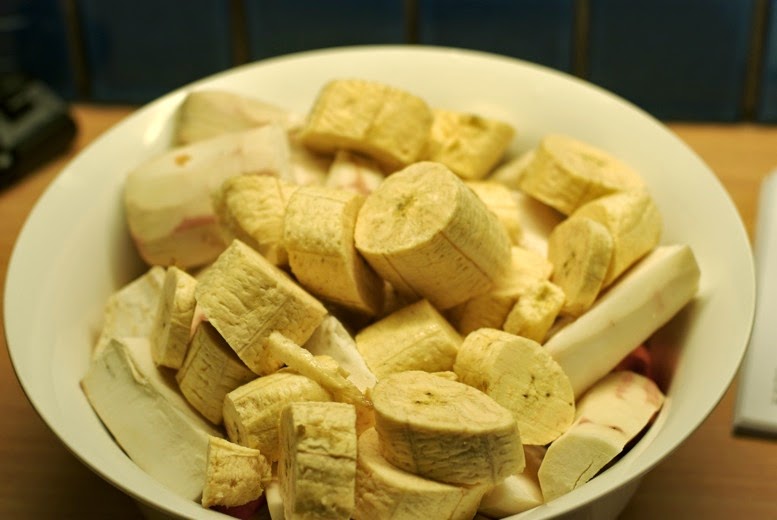
I've been wanting to make that coconut stew since last year, but never got round to it until now. Rondon is very important to the Caribbean coast of Nicaragua traditionally, and has now become the meal that is served at any official gathering or ceremony. It used to be made with leftover food, trying to use the most of your fish, and now it has become a signature dish.

6 Oct 2013

Back in Nicaragua

Bosawás

is where I've been this week. Nadia, one of the girls from my group, came up from Oslo, and we spent two entire days locked up in my family's house in Tromsø, working on choosing images for the photo-book we'll be making and also writing texts and making postcards for our information work.

I've also held two trainings for my Global Dignity volunteers, and will be doing more this coming week. We went to a moustache themed party. I've been to a small festival arranged by the city's oldest bank, been to a book swapping event, a vintage fair and a second hand market, I've watched too many films, too many QI reruns and just enough Friends reruns.

Life is being very busy right now. I'm hoping this will right itself in a little while, and it can go back to just being a normal sort of busy.

7 Aug 2013

Norway, old friend

A recent, not too good, photo of my most photographed view

So, what's it like? Being back in Norway? This Thursday, I'll have been home six weeks, and it feels like nothing.

Because from the second day I was home, it felt completely natural. Maybe because I've travelled before, lived abroad before, and I've returned to Norway from England about nine times while living there. I'm used to things being different at home than abroad. I expect it.

And I fall, quickly, easily, into old routines of toast and juice in the mornings, eating lots of bread, wearing woollen jumpers, black tights and a warm scarf in July, going to cafés to see friends, going out, staying in, seeing my family again.

Nicaragua is suddenly far away, even though I'm writing about it every day (I am spending a loooong time writing one essay).

It's far away until there's a warm breeze, which is almost unheard of in Tromsø (we're used to cold winds, thank you), and a warm evening walk in the breeze with my mum, and I tell her all about the time at Rocky Point when there was a strong breeze, days on end, and we didn't know whether we would be able to take a boat over the lagoon to visit our friend. 

Then I am filled with sadness, because I want to be both places at the same time, and there are laws of physics that say I can't.

22 Jun 2013

Bosawas/Musawas


And then, more about this place I mentioned weeks ago.

One Sunday in May, after the longest bus ride in history, one night of sleeping in a parking lot, one night of sleeping three in one bed, and plenty of long meetings, we walked three hours into the woods and up the mountains in this beautiful natural reserve of Bosawás, to the village of Musawas, where the indigenous Mayangna live. We were supposed to have a meeting with the village, or with one board, or with another, and we spent two hours listening to them discussing in Mayangna about whether we were allowed to have a meeting, and with whom, and why we were even there.

They said they are now sceptical of people coming from outside to "help", because they have several experiences with those who come, appropriate their culture, and run back home to earn money off what they've learnt.

We ended up taking the meeting outside, because apparently our previous agreement wasn't official enough to have a village meeting in the village hall. We split into two groups: one sat around members from the Territorial government, the other around those from the local council (unless I am confusing all these councils again). I was with the territorial government.

Both groups could tell us that yes, they had problems. Mestizoes from the west and south were moving into the reserve, cutting down far too much wood, working for profit rather than survival, and not respecting that it was a reserve, that the indigenous people had the right to use the forest as they had traditionally, but noone else should come and ruin nature. The territorial government people were quick to point out though, that they had done something to prevent it. That the state was completely on their side, all they needed was a little time and these migrants would be kicked out. No problems here. - "But we heard there was an assassination of the past president for the territorial government?" - "NO. Accident. Accident, it was."

Certainly. The people in the other group said clearly that the former president had been killed. Two very different versions. They were also clear about the fact that they do actually have problems, people are still cutting down rain forest, and it's not going to go away just like that. I'm sadly going to believe the most pessimistic view of this last group, which some of the girls got to hear while the rest of us were sat discussing problems with people who claimed not to have any.

23 May 2013

Rainy Season

 Started one day, 26th April, ended the same day, 26th April

And there was nothing to do but get everything in and stay inside

The rainy season here is supposed to be between May and December, and it's the "winter" in Nicaragua. Ms Florence kept saying the 15th of May, and she seems to be right. We started with one day of forewarning, the 26th of April. And I am telling you: Rain. It is amazing and astounding and completely unimaginable, how much it's possible to rain in one day, or at once. And this comes from someone who has lived in Falmouth, England. More rain than the most heavy, hard rainfall you can imagine in Falmouth, and we did have some rain there too. I feel bad for the next group coming here, since they will be here between September and December, and get a lot more winter than us.

14 May 2013

Ms Florence & Don Juan

 The first two weeks of this stay, we were with Ms Florence, her husband Juan and 

 Jack, a monkey they had caught and kept on a leash

 And the most beautiful flower garden at Rocky Point

Here they are: don Juan (89) and Ms Florence (67)

These two are the most amazing couple. They got married when he was 45 and she 23, after he'd followed her to the Atlantic Coast to ask her parents for her hand. They have eleven children, as far as I can remember. Don Juan is a "Spaniard" from the Pacific side of Nicaragua, Ms Florence a creole lady from Rocky Point. He never learned English/Creole English through their 40-odd years of marriage, she speaks a mix of Creole and Spanish, and will just switch over any minute. They both work hard at the farm every day, she wears skirts (and short ones too) no matter what she's doing, chopping, weeding, getting the cows in.

I learned to clean the area around the cocoa trees with machete, ground cocoa beans, and finally, how to cook rice and beans with coconut milk. The new families we've been with now have been amazed at how Johanne and I can grate coconut and make coconut milk, which we've been experts on since we first stayed with Ms Connie. The best thing about this stay was coming back and feeling more at home at Rocky Point - we knew the people, the bus schedules, the small paths through the woods, the cuisine, and it felt like a second home.

16 Apr 2013

Back to our communities

Photo: me
 Johanne and I stayed in Rocky Point, which you've probably heard enough about by now. In short, it is a mostly black creole farmer community, close to Pearl Lagoon, where people live on separate farms. We've learnt how to make coconut oil, and how to eat anything made with coconut and coconut oil.


Photo: Line Bellingmo Johnsrud
 Ingrid and Line stayed in Orinoco, a Garifuna community which lives mainly off fishing. They've learned to dance, drum, make rondon and eat pretty much anything.


Photo: Mathilde Gabrielsen Vikene
 Mathilde, Julie and Nadia have stayed with a school at Wawashang, meeting students from all the different communities and ethnic groups, having classes in Spanish and Geography. They've also stayed at the nature reserve of Kaka Creek, and with a mestizo family on a farm in the area.


Photo: Elise Øksendal
Gro Malene and Elise have stayed in Kakabila, a Miskito community where people live off fishing and farming. They've stayed with many different families, worked with houses, in the woods, and are now going to paint a mural with the children there.

Everyone is going back to their previous communities in the same groups as before. We would have been able to change places - and partners- if we'd wanted, but noone seems to want to. After spending one month getting to know people, getting into a culture and their practices, you don't want to start all over again. All the villages here are distinct from one another, and most of what we hear from one another is different.

14 Apr 2013

New itinerary

10th April: Pearl Lagoon – political program, meetings

14th April: Rocky Point – new families/farms, still with Johanne

10th May: Back to Bluefields. Political program, writing, working with information, planning what to do when we come back to Norway

1st June: Holiday-time, program finished. Spanish school? Pacific Coast? Costa Rica? Who knows?

26th June: Fly home

27th June: ARRIVE in Tromsø

12 Apr 2013

Spoilt child

How most meals are cooked in Rocky Point - this is the improved oven

That's me.

I first realised when I moved to England and moved into student blocks on campus, and everyone else were exclaiming happily about the water pressure in the showers while I complained about the dingyness of the kitchen. The second year there, we moved into a student house, and my Norwegian housemate and I complained about the carpeted floor (difficult to hoover) and the green-painted kitchen. The others were happy to have a student house that mostly worked, albeit without internet the first six months.

What I realised was that even in (Western) Europe, where I'd imagined (I was but 19 years, remember) most things were similar, Norway is a country with a lot of luxuries built-into everyday life. Like constant hot showers.

So when I finally went to Nicaragua in February, I was oddly enough quite prepared for meeting the different standards. Because I'd gone to England, which I find weird. Yes, it did take a while to get used to bucket showers, and having to get water from the well to flush the toilet. But it didn't shock me. And I realised how lucky we were, coming from Norway to visit this country – we all know we're going back to running water and electricity-filled houses.

Then we went to Guatemala, and I realised that even Nicaragua was luxury. Not in terms of water – it's pretty much the same. But in being able to live in peace, without worrying about the state, or companies, taking over your land. Without an active military getting into your business. Living in Nicaragua isn't always that easy either, but people here are more relaxed – because they can be.

So yes, to conclude this jumpy text, I am a spoilt child. Again, sometimes I wonder what we are doing here, coming as visitors to see how people are living, lowering our standards, hearing what they've experienced, happy that it's never happened to us, and then leaving again. To super-ultra-mega-safe Norway, where hardly anything happens. Where we have all the luxuries without realising they are, in fact, luxuries.

11 Apr 2013

Back in safe Nicaragua


I'm back, I'm back! Well, I was back on Monday already. We've been in Bluefields two days, and we're going to Pearl Lagoon to have a program with meetings there, before continuing on to Rocky Point. Pearl Lagoon is the closest town to Rocky Point, so I'm getting closer and closer to my second home.

Coming back from Guatemala, Nicaragua feels like the safest place in the world. Almost. And, as we've been told repeatedly, it (Nicaragua) is one of the safest countries in Central America. We have had our security routines here as well, but they don't differ that much from what I would follow in London or Oslo. Don't walk out alone after dark, don't walk down certain streets/areas after dark even if you are together, and so on.

Guatemala had a lot more security, and it stressed me out. I had some horrible dreams in Guatemala city. My mood changed rapidly, and even if everything looked nice and quiet on the surface, after all we'd been told, it was difficult to feel at ease. It might just be my imagination, but I feel a lot more relaxed after we came back to Nicaragua, and especially Bluefields, which is in an area with a lot of drug traffic.

I'm looking forward to being back at Rocky Point soon – my second home, where you only need to stay away from the mainroad, don't wander the woods after dark and maybe don't go alone too much as a woman.

23 Mar 2013

Program/Itinerary

Cow and house in Kakabila, the village where my two friends Elise and Gro Malene stayed

  • Saturday 23rd: Plan future blog posts, reply to emails and go to my first proper baseball game
  • Sunday 24th: Travel up the Rio Escondido to Rama and beyond, hoping to reach the Pacific Coast by nightfall
  • Monday 25th: Only do nice things, because it's my birthday
  • 26th-31st March: holiday, hopefully relaxing/exploring/finding new amazing stuff
  • 1st-8th April: Political program in Guatemala, meeting lots of organisations and talking to interesting people about autonomy and indigenous people's rights, in addition to a lot that is happening in Guatemala right now
  • 8th-10th April: Political program/relaxing/working on our information work in Bluefields/Pearl Lagoon
  • 11th April-10th May: Second Rocky Point-stay, no idea which farms we'll be going to, yet
  • 10th-31st May: Political program/interviews/planning our information work for Norway, in Bluefields and/or other significant places
  • 1st-26th June: Vacations + travel + learning all the Spanish I haven't learned since living with Creole English-speakers
  • 26th-27th June: Travel home, arrive, meet my parents, eat waffles, sleep

That's a rough outline of the next three months. Some of the dates might change one day or two this way or that, but hopefully mostly it will stay the same.

And yes, I will write more about Rocky Point soon, but it's getting close to 1am, and for someone who's been getting used to going to sleep at 8pm, this is very late indeed.


26 Feb 2013

A short story about autonomy

 URACCAN Campus, Universidad de las Regiones Autónomas de la Costa Caribe Nicaragüense

 People in the street, hello

More people in the park

I've written a far too long text in Norwegian about this, I'll try to keep it short. First about the name of Bluefields: There was a lot of piracy here, often sanctioned by the British Crown, since they looted Spanish ships. One of them was a Dutchman called Blauveldt, which turned into Bluefields, as the city was named after him. 
Spain colonised the western coast of Nicaragua, and England took the east coast, the Caribbean coast, where I am now, as a British protectorate. The indigenous miskitoes of the north collaborated with the British, receiving weapons and goods as a thank you for keeping the Spanish away. There has been a lot of back and forth between the British and the Spanish, and in the end the British signed a treaty saying that they would leave the Nicaraguan coast to Nicaragua, and go up to Belize. So they left, leaving behind plantations with suddenly-free slaves, in addition to the Creole and Garifuna (afro-descendants), and the indigenous peoples of Rama, Mayagna, Ulwa, and Miskito. None of them with a good relationship with the rest of the country, and never having been a united country before.

Almost as from any textbook on how to suppress the indigenous tribes of a country, the government went on to forbid indigenous languages in schools, and impose Spanish language, traditions and property owners on the east coast. The different ethnic groups on this coast were all seen as inferior. There is still a lot of prejudice from people living in the west and north of the country. Even I was told to be careful of people in Bluefields, because they are apparently a lot more likely than anyone else to steal all my things. 

Finally, after the revolution and civil war, there was a lot of will to change in the country. A lot of leaders from the Caribbean worked hard to create a new autonomy law, and they managed to finish it in 1987. The autonomy law is quite progressive, even today. It states that there are two autonomous regions in Nicaragua, the northern and the southern autonomous regions: RAAN and RAAS. They cover about half the country. The forwardness of the law exists in it saying that all ethnic groups are equal, and they are all autonomous, whether they are of Spanish or African descent, or indigenous people. This is pretty strong in a region with so much history about race and origin.

The autonomy law also speaks about the demarcacion (is this a word in English?) of land. The land that was once given to rich friends of those in charge, is supposed to be shared out as communal land between the different communities. No personal ownership. There are a lot of rules and regulations though, a lot of different traditions to consider, and even places where this is impossible to go through with, like Bluefields, which is a city where people have owned their land maybe hundreds of years. Others have their deed scrawled on paper, without witnesses or proper signatures. 

We are going to learn a lot about this (I have learned some already, as you can see from my actually quite short summary). I am already comparing it, and finding that others have compared it before, with the indigenous people of the Nordic countries: the Saami. More about this to come! 

19 Feb 2013

Las Hormiguitas

 People working at Las Hormiguitas, including Alex (to the left) who used to be a student

 Supportive/solidary countries (we are there, among many others)

 Books! Books! Mathilde and I wanted to take them all out and read them, even the ones we don't understand

 Spanish/English lesson for you all

One of their two computers

Last week, the final organisation we met in Matagalpa was Las Hormiguitas (the ants). It's not as much an organisation as a daycare/after school-centre, specifically for children who work. They offer a place to stay at different times of day, and aim to get the children through school in addition to the actual work they do to support their families. They do not try to get the children to stop working, because they know it might be crucial for their families, they only encourage the families to let the children work less, while enhancing the children's education with this day centre.
There are about 100 children enrolled at the moment, mostly from the neighbourhood around the school. You can tell that their work is important, but they are completely dependent on financial support to manage. They have also worked with children who are sniffing glue, an increasing problem in Matagalpa at least, but this is only a side project, and is mostly worked on when specific foreign volunteers come back to visit and/or stay for a while.

The ladies at this centre made it pretty clear for us: Don't give money to starving children in the streets. Buy them food, by all means. Don't buy anything from them, because they'll use the money for glue, or they'll be controlled by someone older or stronger than them who will control the money as well.

It's odd being here and hearing about all these things. We're not really seeing them quite yet, only traces of sad fates when we hear about the work that different organisations do. It hasn't quite struck me yet, that everything I hear is very true and very close. At the moment it feels a bit like listening to or reading the news back home - it's all very sad, but it doesn't really hit home. I probably have a lot of practice from working with the Red Cross, even in Norway.

Of course I can't take it all in, or I would stop functioning, but I wonder whether this will change any time soon.

17 Feb 2013

Cerro El Calvario y mis hermanas

 Of course there are FSLN signs, graffitis and flags everywhere

 Here is Matagalpa city centre, with the blindingly white cathedral

 I loved being up here in the wind and the fresh air

 While the others thought it was a bit too fresh, here's my host sister Yodesca 

 Yodesca, me looking very fresh, and my sisters' friend (Kenya?)

Same friend, Yodesca, and my other host sister Tatiana

When my host family asked me whether I wanted to go up a hill last Sunday, I said yes, because I imagined going up a hill meant walking up a hill. But no, it was too dangerous to walk, and so we took a taxi both ways. It was wonderful to be up there though, and being in the strong wind and feeling slightly more fresh than the rest of the weeks I've been here.

15 Feb 2013

Managua and masculinity

Yesterday morning I left this view from my window (yes, that is the cemetery at bottom right) in Matagalpa, I left my temporary family and went to take a bus to Managua.

Managua is so far very unimpressive, it's a weird city of just highways and some shops and a massive shopping centre, and I can't get my head around it. It has no proper city centre.

Yesterday we met Douglas from Puntos de Encuentro, an organisation that works with women's rights, but also with men's perceptions of themselves, of family and of women and of their own masculinity. Douglas was especially interested in this, and showed us several films, including this one:


Puntos de Encuentro have also made several tv-series (or soaps, really) that bring up important subjects for youth and for girls, and that promote equal rights. They've even made a tv-series about sexual exploitation in Granada, one of Nicaragua's big colonial cities. I think this is a very good way to educate young people, who'll watch what's on telly, and remember it a long time afterwards (speaking from own experience here). All the actors are volunteers, and the producers contact different organisations working with the issue they're covering before writing each episode.

El Cementerio

 Hello Mathilde, and hello massive family mausoleums

 I love the colours of these cemeteries

Look!

The further up on the hill, the poorer you get

The colours from the wedding of a Norwegian princess

Beloved wife, only 20 years of age

Someone who died in 1984 - under the civil war - get to have guns on their grave

People always look oddly at me when I tell them I love cemeteries (so I don't tell many people). Part of our Spanish lesson on Wednesday a week ago was learning the story behind the Matagalpa Cemeteries, then going there. They have a "Foreigners" cemetery as well as a "Locals" cemetery, which in reality was "Catholic" and "Non-Catholic (the Foreigners)", and it's really interesting to see the differences between the two. Carlota, for example, was a foreigner or a foreigner's wife, and her tomb stone is very classic, white, and sobre. As you can see, a lot on the Local cemetery were not. Cemeteries also tell a lot about who were rich and poor, and about a country's history (see the gun tombstone). If you've followed this blog before, you've seen me ranting about cemeteries before, so I'll leave you here.

I've written this post beforehand, since I don't have internet all the time, but if all goes well, I shall be in Managua - the capital - when this gets posted. We're staying there two days, Thursday to Saturday, when we move on to Bluefields: one step closer to where we're going to live. We'll be having a week's long intro course in Bluefields as well, which probably means internet, but between February 24th and March 24th, I'll be staying with a family or on a center far away from the city, so don't expect much in that period - and send me any important messages before the 24th of February!

10 Feb 2013

First days

 We stayed in a hostel a few days, this is the level of tidiness we had (and Julie working hard)

 And this is us getting used to a different culture, a different country, and different ways of doing things

 We had one day off, where we went to a waterfall, here is Line eating some fruit or other

 And Julie being mysterious down by the water

And someone hiding behind Cascada Blanca (the White Waterfall)

I've got so many photos. I decided to start with first things first, so you'll always be a bit behind me, but hopefully never that far behind. I'm behind you all in time anyway, at the moment of writing we are nearing 0530 pm in Matagalpa, while my parents have gone to bed in Norway at 0030 am.
This second day, we went early in the morning to get a bus to the waterfall, which was our (or mine, at least) first proper experience with a Latin American bus. It was stuffed with people and food and a chicken in a box, all the clichés. The only thing that surprised me (but probably shouldn't have) was how noone got up for women and children and old people. After ten days in this country, I've seen someone get up for someone else once, and that was a man getting up for a pregnant woman to sit. 

We have two coordinators that have lived many years in Mexico, but also spent time in different countries in Latin America before - even though they've never lived in Nicaragua proper, they're very good to have for experience. Our two translators, Ingrid and Elise, have also lived in Guatemala and Bolivia respectively.

Soon to come more about our first week in Matagalpa!